


Meteors Hurting Humans: Actually Quite Common!
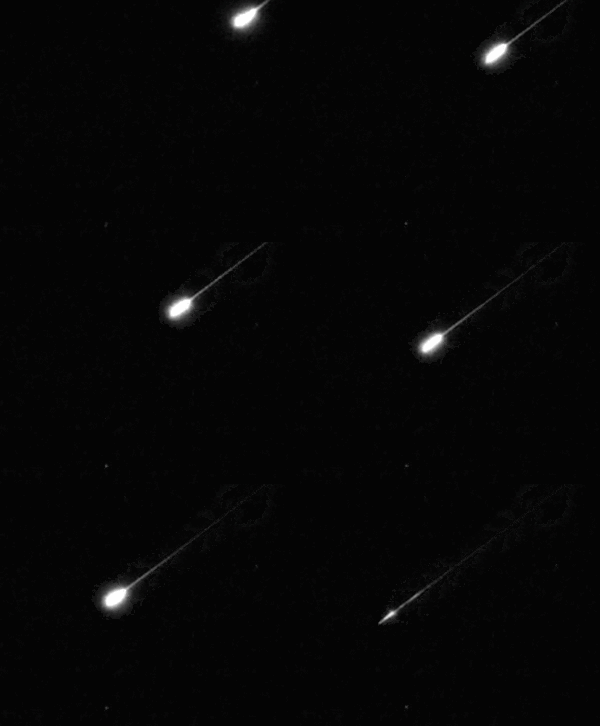
In my book Survive 2o12, the appendix on the threat of asteroids and comets (follow the link to read it online) lists reports of modern era meteorites that have killed people or animals – it’s not a small list:
- 588 AD, 10 people, China
- 1490, supposedly 10,000 people, China
- 1511, Franciscan monk, Cremona, Italy
- 1650, Another monk (!), Milan, Italy
- 1647-54, 2 sailors at sea
- 1790, A farmer and cattle, France
- 1825 , A man, India
- 1827, A man, India
- 1874, Child, China
- 1879, Man in bed, Indiana, USA
- 1879, Farmer, France
- 1897, Horse, West Virginia, USA
- 1907, Entire family, China
- 1908, 2 people reported, Tunguska
- 1911, Dog, Egypt
- 1929, 1 member of a bridal party, Zvezvan, Yugoslavia
(Some debunkers have previously told me that I should not be taking these reports seriously… maybe this week they have changed their minds…)
So the recent Russian meteor storm wasn’t a surprise for me. Given that the Earth is 2/3 ocean (and therefore unlikely to be spotted), and the last major incident was Tunguska in 1908, you could guess that this happens somewhere roughly every 30 years. In fact meteor airbursts that don’t injure anyone are currently happening annually:
Wikipedia: 9 Meteor Airbursts in the last decade
One of these were mentioned in my book, while the second escaped the Wikipedia list:
In 1930, three asteroid fragments struck a Brazilian jungle and 1,300 square kilometers of rain forest were destroyed by wall of fire.
On February 1, 1994, near the Marshall Islands in the western Pacific, a handful of fishermen witnessed a hundred-kiloton explosion (that’s 10x Hiroshima) that momentarily flashed brighter than the sun. This asteroid has been estimated to be just 6-17 meters across, but plenty sufficient to decimate a city – so it was extremely fortunate (for humans) that it exploded above the ocean.
Here are some related reports from this blog over the last few years:
- German schoolboy hit by meteorite – leaves a scar on his hand
- July 2012: 30 meter meteor hits India
- Nov 2010: Meteorite hits Java home – damaged the roof, kitchen and dining room, fortunately no injuries
- Sep 2010: Meteor hits Colombia – leaves a 100 meter crater!
- Aug 2010: British man hit by meteorite – while outside watching cricket
You might have noticed that I use meteor/meteorite interchangeably. Here are the strict definitions:
- A meteoroid is a sand- to boulder-sized particle of debris in the Solar System.
- A larger particle is an asteroid.
- A meteor is the visible streak of light from a meteoroid, otherwise known as a “shooting star” or “falling star”.
- If a meteoroid reaches the ground and survives impact, then it is called a meteorite.


