


Galactic Center Collision Due Mid-2013
Note: this is unlikely to affect us here on Earth, but you never know…
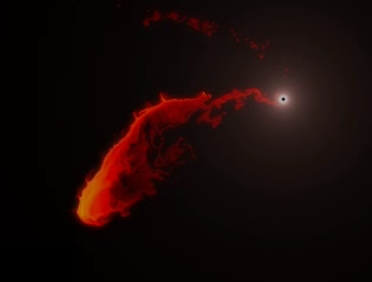
…a gas cloud with three times Earth’s mass heading towards the usually placid supermassive black hole at the centre of the galaxy. The collision won’t be visible to the naked eye, but X-ray telescopes will pick up radiation from the shock wave created as the cloud slams into the halo of hot gas around the hole.
As the black hole, called Sagittarius A*, sits a mere 25,000 light years away – on our cosmic doorstep – the crash should provide an unprecedented view of material ploughing into a black hole. It could even yield important clues about what happened 300 years ago, when the black hole was much brighter than now.
Source: New Scientist
The black hole at the centre of the galaxy, formally known as Sagittarius A*, fascinates scientists. By mid-2013 a gas cloud is expected to pass in its vicinity at a distance of only 36 light-hours (equivalent to 40.000.000.000km), which is extremely close in astronomical terms.
For the past 20 years, Stefan Gillessen, astrophysicist at the Max Planck Institute for Extraterrestrial Physics in Munich, Germany, has been observing the black hole. “So far there were only two stars that came that close to Sagittarius A*”, he says. “They passed unharmed, but this time will be different: the gas cloud will be completely ripped apart by the tidal forces of the black hole.” A black hole is what remains after a super massive star dies. When the “fuel” of a star runs low, it will first swell and then collapse to a dense core. If this remnant core has more than three times the mass of our Sun, it will transform to a black hole.
Source: Youris.com (watch the video there)
Because this is the first time it has been observed, and because bodies in space (especially stars and black holes) keep on surprising scientists… expect the unexpected!
But no, the ancient Maya didn’t predict this.


