


A Great Prepper Image
A family and their survival gear, food and water:
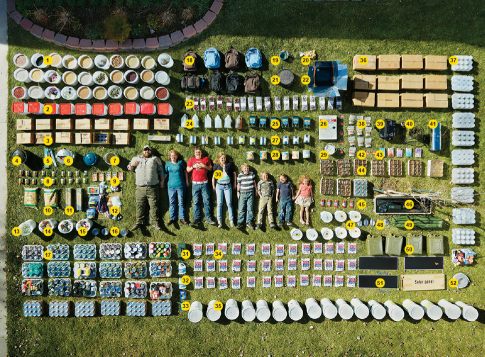
The article it comes from (at NY Times) is well worth reading, and has the full size of the image and lists what all their survival items are.
It discusses the prepping industry and expos. Some brief excerpts:
Douglas talked about emergency preparedness, sustainable living and financial security — what he called the three pillars of self-reliance. He detailed the importance of solar panels, gardens, water storage and food stockpiles. People shouldn’t just have 72-hour emergency kits for when the power grid goes down; they should learn how to live on their own. It’s a message that Douglas is trying to move from the fringe to the mainstream.
…Five expos this year have drawn 40,000 people who pay $10 each. The radio network has logged more than two million podcast downloads; in one day alone in July, it reported nearly 90,000 downloads. The book, which was first published in 1974, includes recipes for everything from wild pig (“they are easy to prepare”) to dove pie (“simmer for one hour or until doves are tender”). Douglas said it had sold about 20,000 copies this year.
…The last time anything like Douglas’s expos hit convention halls was the 1990s. Y2K was coming. The threat of computers — and everything else — failing was a boon for a show called the Preparedness Expo. Civil rights organizations denounced the early incarnations of these gatherings, organized by a Utah man named Dan Chittock, as havens for political extremism and hate, an image that Chittock disputed even as he seemed to invite it.
…But when the millennium dawned without widespread computer meltdowns, Chittock’s audience disappeared, and the expos disbanded. “It was kind of like crying ‘wolf,’ ” Chittock says. “Nobody wanted to hear it anymore.” Many small survivalist companies folded, while others struggled to carry on. Sun Ovens International, an Illinois company that manufactures solar-powered ovens, had sales fall to less than $200,000 in 2000 from $1.6 million a year earlier — a staggering 88 percent decline made worse by the fact that the company got stuck with $100,000 in unpaid invoices after the Y2K bust. “When Y2K was a nonevent, almost everybody in the preparedness industry declared bankruptcy,”


