


2012 Fact #1: The Long Count Calendar
The ancient Mayans had roughly 20 calendars, all of which were short in duration, with the cycles equating to astronomical phenomena, or were intended to relate to history repeating over and over again via prophecy. Except for the Long Count calendar. The Long Count is the Mayan equivalent of our calendar, in that it assigns unique dates over a long period of time. A short numerical description (like 12/6/1976 in our calendar) pinpoints a place in time. Unlike our calendar, which starts with the birth of Christ and heads towards infinity in two directions, the Long Count has a definite beginning and a definite end.
The start date of the Long Count calendar rarely gets a mention, and few experts have attempted to explain why this date, August 11, 3114BC, was chosen. Many independent researchers have noticed that the era of 3114BC includes the rise of multiple civilizations (especially the Egyptians), and the construction of the Egyptian pyramids, Stonehenge, and other ancient monuments.
The end date is accepted by scholars to be Dec 21, 2012. The only fact regarding this date is that it is the winter solstice in the northern hemisphere. For the “end of the world” to occur on the darkest day of the year is either by design, or a coincidence. 2012 is in the “era” of a galactic alignment hat occurs during winter solstices at present.
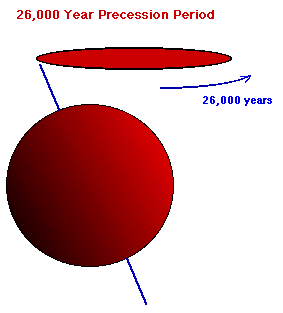
The length of the calendar is 5125 years (some say 5126 years, but they have forgotten we do not have a year zero in our calendar). Several researchers have noticed that this is close to one-fifth of the precession of the ecliptic, which completes every 26,000 years or so. Consequently five ages or “worlds” the length of the Long Count calendar would fit quite neatly into one cycle of precession.
This is an excerpt from my ebook 2012: Myths and Facts


