


Purposeful Evolution
My 2012 studies began with Graham Hancock’s Fingerprints of the Gods, where he suggested that ancient cataclysms may have destroyed advanced civilizations, and that 2012 could be a prediction for the same again.
So while thinking about a global cataclysm 12,000 years ago, I pondered over why it was only recently that humans started achieving stuff – if anatomically modern humans have been around for 200,000 years, why did we only start acting modern 12,000 years ago? And then I thought about Neanderthals, and the Biblical Nephilim, and how all the human fossils that have ever been found could fit into the back of a pickup truck. And I wondered whether dragons and unicorns were once real…
…and it struck me that evolution occurred 12,000 years ago. Evolution occurs in more ways than bones can express.
The cause is unknown. It might have been purely a physical disaster, where a decimation of the population led to evolution via punctuated equilibrium – but that would most likely result in too many human species. So I thought the cataclysm could have been caused by (or accompanied by) a mass influx of cosmic rays. Cosmic rays are the current cause of a large portion of human mutations.
But wouldn’t that just mean that everyone got sick, and mutated in non-beneficial and non-evolutionary ways? Perhaps not:
In 1988, internationally prominent geneticist John Cairns challenged science’s established belief in random evolution. He chose bacteria with a crippled gene that made a defective version of the enzyme needed to disgest lactose, a sugar present in milk. He then inoculated these lactase-deficient bacteria into cultures where the only nutrient was lactose. Unable to metabolize the nutrient, the bacteria could neither grow nor reproduce, so no colonies were expected to appear in any of the experiments. Yet, surprisingly, a large number of cultures expressed growth of bacterial colonies.
Sampling the bacteria that he started with, Cairns found that mutated forms did not exist in the original inoculum (where nutrition was not limited to lactose). So, he concluded that lactase gene mutations followed, rather than preceded, their exposure to ter new (lactose only) environment. Unlike prior experiments which resulted in the almost instantaneous death of bacteria exposed to viruses which attacked them, Cairns’ experiment starved them slowly. In other words, Cairns gave the stressed bacteria sufficient time to engage and activate innate mutation-producing mechanisms in order to survive.
In Cairns’ study,life-sustaining mutations appeared to arise as a direct respponse to a traumatic environmental crisis. Interestingly, further assays revealed that only the genes associated with lactose metabolism were affected. In addition, out of 5 possible different mutation mechanisms, all of the surviving bacteria expressed the exact same type of mutation. Clearly, the reults do not support the assumption of totally random mutations and purposeless evolution!
[Source: Spontaneous Evolution by Bruce Lipton and Steve Bhaerman, page 149]
Combine this with the rapidly growing field of epigenetic inheritance, and it is starting to look like our “junk” DNA is capable of steering evolution in a purposeful manner. All it takes is a shock to our collective system, and a global cataclysm would do it.
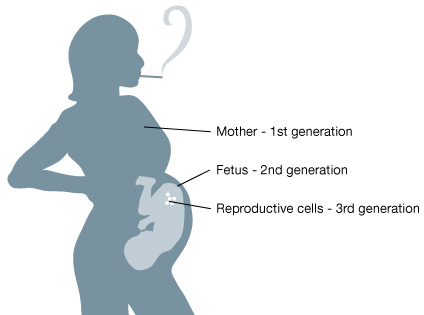
So far studies that prove some form of epigenetic inheritance have looked at small population sets from recent time, like Hiroshima or a famine early last century. What doomsday science needs is a scientist in this field to speculate on a global event that caused universal epigenetic inheritance.


