

Dark Comets »

Another Expert Agrees With Dark Comet Theory

February 21, 2013 – 11:31 am | No Comment

Astronomer David Asher (from Armagh University) has agreed with Bill Napier and Janaki Wickramasinghe (Cardiff University) that “dark comets” are real and dangerous.
The following quotes are from a paper by Napier and Asher published in Astronomy & Geophysics.
http://star.arm.ac.uk/preprints/2009/539.pdf

We know that about one bright comet (of absolute magnitude as bright as 7, comparable to Halley’s Comet) arrives in the visibility zone (perihelion q<5AU, say) each year from the Oort cloud. It seems to be securely established that ~1–2% of these are captured into Halleytype (HT) orbits. The dynamical lifetime of a body in such an orbit can be estimated, from which the expected number of HT comets is perhaps ~3000. The actual number of active HT comets is ~25. This discrepancy of at least two powers of 10 in the expected impact rate from comets as deduced from this theoretical argument on the one hand, and observations on the other, is …

Read the full story »
Bunkers

From DIY to Russian megabunkers

Survivalism

Preparing for when the SHTF

Pole Shift

Crustal displacements and magnetic pole shift – both are scary

Comets

Don’t believe NASA – these are a genuine threat

Earthquakes

More likely during eclipses and perhaps Comet Elenin is a factor?

Home » DNA, UFOs

DNA as a Storage Medium
Submitted by on August 17, 2012 – 6:11 amNo Comment

I’m always on the lookout for new forms of data storage, because it is important that knowledge is retained beyond any global disaster. Not only is this a marvelous new method, but it also suggests either in the past (alien intervention anyone?) or the future knowledge might be stored in living creatures or plants.

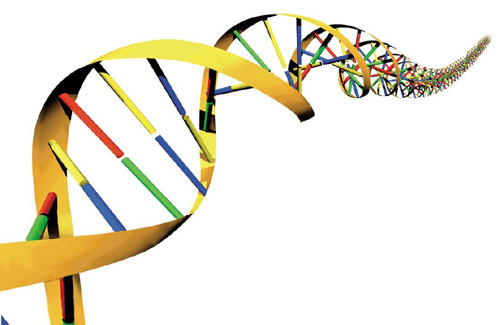
When it comes to storing information, hard drives don’t hold a candle to DNA. Our genetic code packs billions of gigabytes into a single gram. A mere milligram of the molecule could encode the complete text of every book in the Library of Congress and have plenty of room to spare.

…an inkjet printer embeds short fragments of chemically synthesized DNA onto the surface of a tiny glass chip. To encode a digital file, researchers divide it into tiny blocks of data and convert these data not into the 1s and 0s of typical digital storage media, but rather into DNA’s four-letter alphabet of As, Cs, Gs, and Ts.

…To demonstrate its system in action, the team used the DNA chips to encode a genetics book co-authored by Church. It worked. After converting the book into DNA and translating it back into digital form, the team’s system had a raw error rate of only two errors per million bits, amounting to a few single-letter typos. That is on par with DVDs and far better than magnetic hard drives.
[via Science magazine]

At this stage the DNA is synthetic – not a bad thing in terms of storage, but certainly not built into anything living. And the other side of the coin  is that anyone receiving the data needs to know it is there, and have access to a DNA sequencer.

Leave a comment!

Add your comment below, or trackback from your own site. You can also subscribe to these comments via RSS.

Be nice. Keep it clean. Stay on topic. No spam.

You can use these tags:
<a href="" title=""> <abbr title=""> <acronym title=""> <b> <blockquote cite=""> <cite> <code> <del datetime=""> <em> <i> <q cite=""> <s> <strike> <strong>

This is a Gravatar-enabled weblog. To get your own globally-recognized-avatar, please register at Gravatar.