


8.0 Quake Due in NZ
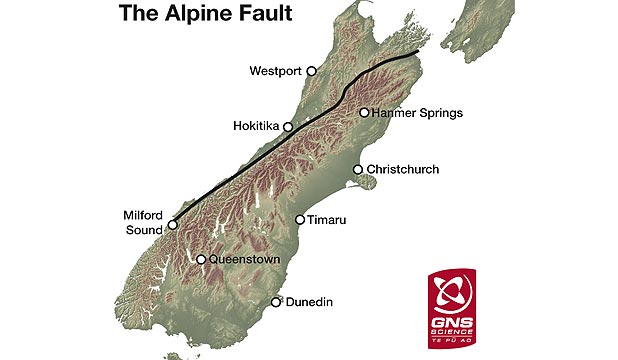
It’s an inexact science, but generally pressure builds up along fault lines, and earthquakes happen in roughly regular manner. Seismologists can’t tell us the day or even year of a major earthquake, but they are pretty good at calculating when a big one is approximately due. And despite quakes in the last couple of years, big ones are kinda due for California, New Madrid, Japan and New Zealand. I would expect that one of these places will have their biggest quake for a long time during the current decade.
It has now been determined that there is an extra likelihood on NZ having a big quake soon. The West Coast might be sparsely populated, but Queenstown is mentioned, and that’s a special place for many Kiwis and tourists:
GNS Science and University of Nevada-Reno scientists have found that the southern part of the 800 kilometre-long fault – which runs along the western edge of the Southern Alps from Marlborough to Milford Sound – causes quakes of around magnitude 8 every 330 years on average.
Dating leaves and seeds from a river terrace at Hokuri Creek near Lake McKerrow in far northwestern Southland, just north of Milford Sound, revealed 24 Alpine Fault quakes between 6000BC and the present.
Other research has found the most recent was in 1717, meaning the next may be only 30 or 40 years away, based on averages.
Professor Richard Norris, from the geology department at Otago University, said the Alpine Fault had the highest level of probability for rupture of any fault in New Zealand.
…Project leader Kelvin Berryman of GNS Science said “a major earthquake in the near future would not be a surprise”.
“Equally it could be up to 100 years away. The bottom line is, if not in our lifetimes then increasingly likely in our children’s or our grandchildren’s.”
…Most recurrence intervals longer than 295 years – the position now – were shorter than 400 years, and many were only slightly longer than 295 years.
“That is, most of the time when a quake hasn’t happened for 295 years, it happens within the next century and often within the next half-century. … The risks are high, but that’s because it seems to be an unusually regular fault.”


