


Mass Grave of Giant Wombats
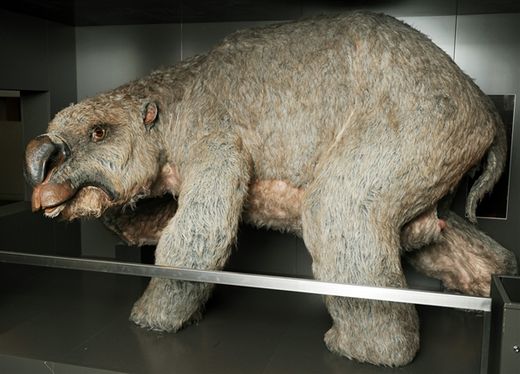
So big were these marsupials that an adult human could fit in their pouch. The Diprotodon (giant wombat) is a great example of megafaunal extinction, and Australian scientists have uncovered the fossils of 50 of these animals. And as usual, the reason for their demise is about as far from global cataclysm as you can get:
He said it was thought the animals died after they became trapped in a bog.
Fifty of them. A stampede of giant wombats? But then the plot thickens:
The remains of other species, such as 20-foot lizards called megalania and giant crocodiles, were also found at the site.
“We’re almost certain that most of these carcasses of diprotodon have been torn apart by both the crocodiles and the lizards, because we’ve found shed teeth within their skeletons from both animals,” Hocknull told the BBC.
Intermingled bones of disparate species in caves and bogs have been found globally, and I count them as evidence for a global cataclysm in the past:
All around the globe there are caves which are full of bones. Many of these contain the remains of animals that would not have normally existed alongside each other. One such cave, at Oreston, near Plymouth, England contained mammoths, rhinoceroses, bears, lions and reindeer. Kent’s cave in nearby Torquay yielded, amongst another things, the bones of sabre-toothed tigers.
A cave near Settle, in West Yorkshire, contains the remains of the hippo, rhino, mammoth, bison, hyena and other animals. They are buried under twelve feet of clay deposits and the cave is 1450 feet above sea level.
Or, similarly, we have the La Brea tar pits, where they found the remains of 100,000 birds (138 species, 19 of which are extinct), 700 sabre-tooth tigers, wolf skulls and 3 species of fish at an average of twenty bodies per cubic yard.
Or 67 dinosaurs in 1 quarry (drought they say).
All around the world stupid animals supposedly got stuck in tar pits or bogs. And then ate each other causing their bones to get jumbled together. All at roughly the same period of time. And only on one side of the globe – Russia, the Americas and Australia. Yet scientists prefer curl up into a fetal position and pretend that cataclysms have never occurred.


