


Humans: Insanely Optimistic
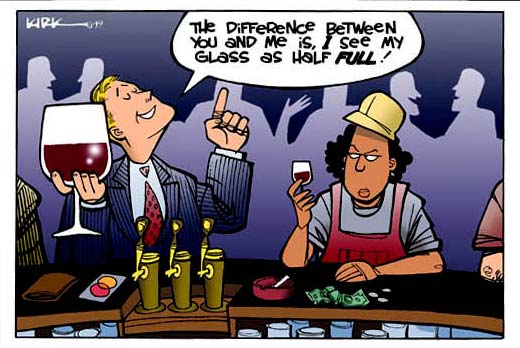
Insane is probably too harsh. And I doubt the study accounted for race or culture, or even age. Still, it has been demonstrated that people are generally optimistic, and revise their opinions much more readily when given good news rather than bad. Or, in other words, if someone tells an optimist the world might end in 2o12, they pretty much cover their ears.
In a study published October 9 inNature Neuroscience, researchers at the Wellcome Trust Centre for Neuroimaging at UCL (University College London) show that people who are very optimistic about the outcome of events tend to learn only from information that reinforces their rose-tinted view of the world.
80% of people were optimists, even if they would not label themselves as such.
…Each was asked how likely 80 different “bad events” – including a divorce or having cancer – were to happen. They were then told how likely this was in reality. At the end of the session, the participants were asked to rate the probabilities again.
Dr Tali Sharot, lead researcher, gave the example of the risk of cancer being set at 30%. If the patient thought their risk was 40%, then at the end of the experiment they downgraded their own risk to about 31%, she said. However, if the patient originally thought their risk was 10%, they only marginally increased their risk – they “leaned a little bit, but not a lot”. [BBC]
The results of the brain scans suggested why this might be the case. All participants showed increased activity in the frontal lobes of the brain when the information given was better than expected, this activity actively processed the information to recalculate an estimate. However, when the information was worse than estimated, the more optimistic a participant was (according to the personality questionnaire), the less efficiently activity in these frontal regions coded for it, suggesting they were disregarding the evidence presented to them. [Science Daily]
BTW, optimism is good for your health, in general. It’s just when people are overly optimistic about serious dangers that things could fall apart.
“Seeing the glass as half full rather than half empty can be a positive thing — it can lower stress and anxiety and be good for our health and well-being,” explains Dr Tali Sharot. “But it can also mean that we are less likely to take precautionary action, such as practising safe sex or saving for retirement. So why don’t we learn from cautionary information?”
Dr Sharot adds: “Our study suggests that we pick and choose the information that we listen to. The more optimistic we are, the less likely we are to be influenced by negative information about the future. This can have benefits for our mental health, but there are obvious downsides. Many experts believe the financial crisis in 2008 was precipitated by analysts overestimating the performance of their assets even in the face of clear evidence to the contrary.”


