


Potentially Hazardous Asteroids
Until recently the NASA mantra regarding an asteroid impact in 2012 went like this:
We already know there is no asteroid large enough to produce a mass extinction that is in an Earth-crossing orbit today. We have found at least 90% of those large enough to threaten civilization.
NASA is referring to asteroids wider than 1 kilometer. So far they have discovered 843 of those large asteroids (as of May 2012), and figure that accounts for 93% of them. Or, for a more worrisome description, they believe there are still 64 asteroids out there that can threaten civilization, and we don’t know where.
Lesser asteroids can still cause significant harm. NASA is also looking for medium-sized asteroids that are between 100 meters and 1 kilometer in diameter. They are “big enough to survive passing through Earth’s atmosphere and cause damage on a regional, or greater, scale“. This is especially true if they cause a tsunami upon impact. By greater than regional I guess they mean continental scale. I guess they mean that a lot of civilization could be wiped out, just not all of it.
Here’s the latest news:
Potentially Hazardous Asteroids (PHAs) are about twice as common as originally thought, according to new research by NASA.
Source: Planetsave
Potentially Hazardous Asteroids are the not the same as Near Earth Asteroids. The primary difference is that a PHA crosses Earth’s orbit, whereas a NEA is outside of our orbit and would require an outside force to knock it into our path. Or the orbit could be changing in the long term.
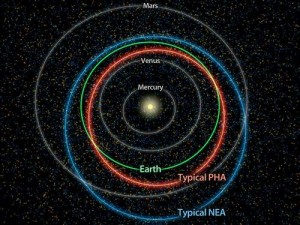
There are roughly 4,700 (plus or minus 1,500) potentially hazardous asteroids (PHAs) with diameters larger than 330 feet (about 100 meters). So far, an estimated 20 to 30 percent of these objects have been found, according to observations from NASA’s Wide-field Infrared Survey Explorer (WISE), which have led to the best assessment yet of our solar system’s population of potentially hazardous asteroids.
Source: Universe Today
Or in other words, thousands that could be heading towards us right now. So when NASA assure us that there is nothing to worry about, don’t believe them. Do your own research, and prepare for the worst, just in case.


Well, at least we have front row seats…
Lately, I can’t stop wondering what your hidden agenda is … Is it your upcoming book, do you have some nice income on this website and the ads or is it something bigger ?
While it is still in the 2012-meme, you are jumping from one possibility to another without making any hard evidence. Is this what you are calling ‘doing own research’ ??? Well, let me tell you : it ain’t ! Doing your own research holds a bit more than just surfing around the web and gathering information from different – mostly obscure and lack-of-evidence – websites or sources.
Well, I guess you’ve giving up on me answering my critics. As always, when too difficult questions are being asked, evasive behaviour is the best to keep going.
Even if Kristin is correct and Rob does have his own agenda, whether
it is possibly sales of an upcoming book,or if in fact Rob turns out
to be the ANTI-CHRIST(LOL) who cares if he FINALLY makes a buck or two
after having created wonderfully informative websites offering a great variety of science related news articles. I find myself in debt to Rob
for helping me attain a level of awareness that I had never before
experienced. Hey Kristin,let’s see what you have to share?
@kirsten:
Nobody knows what will happen on Dec 21, 2012 – if anything. So I try to provide full coverage of all the vaguely possible possibilities.
If you check out the main site, there are original articles on Comet Caesar, Earthquakes and Eclipses, and Noah’s Ark in Iran. These are examples of where I have made extensive research and come up with totally original ideas.
But often posts here are just curiousities, ideas for readers to potetnially follow up themselves. They are of interest to 2012ers, but not of enough interest to me for me to spend a week of research on.
(in case you didn’t realise, the time I have left for research is short…)