


Solar Pole Imbalance Mystery
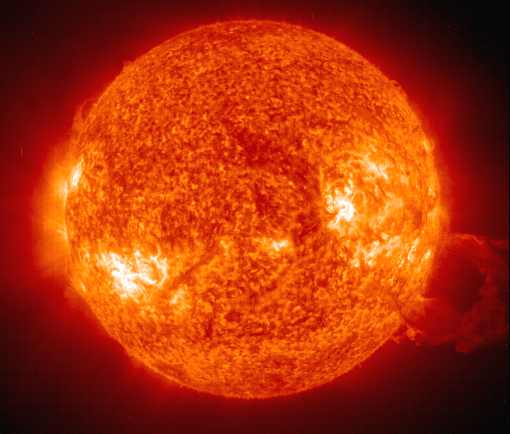
Our Sun operates on a cycle that takes roughly 11 years to complete. While the key indicator for when the cycle is at its peak is the number of sun spots, the root cause is the reversal of the Sun’s magnetic poles. And for some reason that scientists cannot explain, the Sun’s poles are currently out of step with each other:
“Right now, there’s an imbalance between the north and the south poles,” Jonathan Cirtain, NASA’s project scientist for a Japanese solar mission called Hinode, in a recent article on NASA’s website. “The north is already in transition, well ahead of the south pole, and we don’t understand why.”
Further, the asymmetrically reversing solar magnetic field could have an effect on Earth, resulting in increased solar flares and the accompanying bursts of radioactive particles called “coronal mass ejections,” or CMEs, that can hit Earth and cause brilliant Northern Lights displays and problematic geomagnetic solar storms, according to NASA scientists.
“This usually leads to a double peak in the sunspot number and CME rate as a function of time…”
The mismatched poles have been observed before, so the real message here is that the Sun’s activity can vary quite a lot, and scientists have yet to create a model that will tell us what it will do next (according to NASA). The Sun might just surprise us with something later in the year.
Meanwhile, Japanese researchers have suggested that the Sun might end up having four poles, as early as this month:
If that trend continues, the north pole could complete its flip in May 2012 but create a four-pole magnetic structure in the sun, with two new poles created in the vicinity of the equator of our closest star.
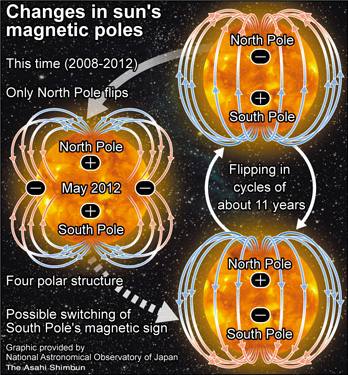
Patrick Geryl has suggested that the new four-pole structure could occur during May 13-15 due to a planetary alignment.


