


2012: Year of the Dragon
In the Chinese calendar, 2012 is the year of the dragon. It is the only of their 12 years that is named after a fictional animal. So are dragons really fictional?
I have investigated the possibility that dragons lived in historical times, primarily because a good book on the topic didn’t exist – see my 6 pages about Did Dragons Exist? I found that dragon myths can be found worldwide, and aside from the very obvious Komodo Dragon, there is another candidate that could explain dragons:
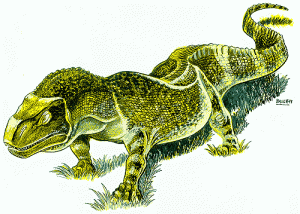
Megalania prisca, as we have learned from fossil evidence, lived in Australia, grew to be a staggering seven metres in length and weighed 600 kgs!
Finally someone has written a proper book on the topic, and I’m pleased to see that the author, trained zoologist Richard Freeman, agrees with me:
“I am absolutely certain, having reviewed many ancient reports of dragon activity, that many sightings – perhaps two or three hundred years ago and probably further back – were genuine encounters, but where the witnesses were seeing what I believe to have been huge snakes, giant crocodiles, and the Australian ‘monster lizard’ Megalania.”
Dragons: More Than a Myth is available at Amazon.
But what do dragons have to do with 2012?
The last two times the Long Count calendar ended, humans seem to have made great advances, and I have speculated that we evolved mentally, 5,000 and 10,000 years ago. A global cataclysm involving the Sun, the Earth’s magnetic field or a Galactic Superwave could include a mass influx of cosmic rays, leading to DNA damage and perhaps evolution.
Many evolved species could have been short-lived, because they weren’t quite right. Perhaps the unicorn and dragon were just that, mutated species that stuck around just long enough to become legend, but not long enough for us to have found fossil evidence?


