


Wired & The Science of Doomsday
After all the poorly written 2012 news items of recent weeks, Wired has come out with an excellent article on the scientific possibilities of doomsday. I’ve summarized their list and added my comments:
SuperVolcano
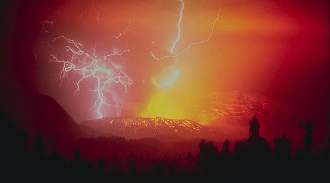
Wired: Yellowstone’s giant volcanic crater has risen about 10 inches in the last decade, suggesting molten rock may be building up underneath. During its lifetime, the megavolcano has probably experienced more than a dozen giant eruptions, Lay says. Lately, it’s been blowing off steam through little vents, but it’s unclear whether it’s gearing up for another Earth-shattering blast.
Rob: The scenarios that scientists should be wary of dismissing are those that have not been witnessed in the modern era. Supervolcanoes might have unique symptoms of an impending eruption. And there’s always the chance that they give us no warning. While they are a major long-term risk, the odds of one erupting in 2012 is low.
Asteroid Accident
Wired: NASA expects that roughly every 100 years, an asteroid larger than 55 yards wide will strike. The impact could cause local catastrophes like massive floods, destruction of entire cities and agricultural collapse. Around once every few 100,000 years, chunks of rock more than three-fifths of a mile wide — the equivalent of about 12 New York City blocks — could come tumbling through the atmosphere causing much more serious problems, on a global scale.
Rob: It is generally accepted that an asteroid needs to be at least 50 meters wide to avoid breaking up in the Earth’s atmosphere. Below that it is unlikely to harm anything that is not directly in its path. If Tunguska was an asteroid, it was perhaps 50 meters wide, causing widespread devastation in a sparsely populated area. If a large asteroid strikes the ocean, then a tsunami would be expected. The sort of asteroid that could threaten human civilization is not expected any time soon – NASA has done a great job of cataloging and tracking them all, and none are headed our way this century.
Comet Collision
Wired: Comets zoom through space at almost 100,000 mph and pick up speed due to Earth’s gravitational pull, he said. The faster an object moves, the bigger the force it exerts on whatever it happens to hit and the more energy it deposits. For Earth, that means more damage. For humans, it may spell out R.I.P.
To add insult to potential injury, finding comets in the outer solar system is very difficult because these dirty snowballs are extremely dark.
But when comet gets within about 390 million miles from Earth, the sun heats comets’ dark surface and starts to warm its icy interior, making it spew out the dust and gas that form its distinctively bright tails.
Rob: So I did the math and that means we don’t see a comet’s tail until it is just 162 days away from impact. The return of a long term comet could have been predicted by the ancients for 2012. And given that such predictions are extremely difficult to make, they could have got the date wrong by a decade or two. Or to put it another way, they were unlikely to get it right to the very day (Dec 21 2012). Either way, we won’t have much warning from the scientists.
Algal Apocalypse
Rob: Interesting idea but would take millions of years, if it was to happen.
Killer Contagion
Wired: “For a virus to kill all humans on Earth, it would have to kill rapidly, like a week or less,” Huang said. If it took any longer, the immune system would have time to attack it.
Rob: From a survivalist point of view, a virus that only kills 10% or 20% of the population is incentive enough to have a strategy in place, where you hide out for 6 months. And virus that nasty is well overdue according to all the experts.
Suicidal Supernova
Wired: Luckily, most will happen at a safe distance of 5 to 10 parsecs, or 16.5 to 33 light-years — too far away to do any real damage.
Rob: We are still learning about supernovae. Just because we haven’t observed one that could do harm from further away, doesn’t mean it doesn’t exist.
Orbital Obliteration
Wired: Jupiter is the most massive planet in the sun’s posse. As such, it tugs at the orbits of the other planets. Over millions of years, the gaseous giant could bully tiny Mercury’s elliptical orbit so much that the farthest distance it travels away from the sun increases, and the closest point gets closer.
…in the worst-case scenario, Mercury and Earth could collide. The impact would destroy Earth even though our planet has about 20 times the mass of Mercury.
Thinking about “orbits going unstable adds a little spice of danger” to planetary science, Laughlin said. But there’s only about a 1 percent chance any of these situations will pan out in the next 5 billion years.
Rob: Orbits are much more unstable and unpredictable than commonly thought. Try finding tables or software that can tell you where a planet will be 1000 years from now! This article doesn’t mention what could happen if an interloper turns up – say a phantom planet passing through or even a Planet X / Nibiru that is an integral part of our solar system, or even Walter Cruttenden’s Lost Star. There are many objects that in theory could disturb the balance, although we would see them by now if they were going to cause a 2012 event.
Solar Slaughter
Rob: Same old story that won’t be newsworthy until billions of years from now. Yes, our Sun has a use-by date.


