


Ancient Mayans Could Measure Solar Activity
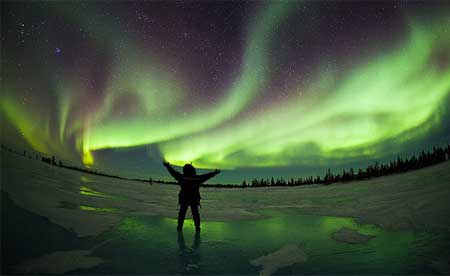
Many ancient cultures knew of planets that could not be seen with the naked eye, and therefore it is possible they counted sunspots as well. Yet there is a far easier way to keep track of solar activity: the Aurora Borealis (or northern lights) is a crude indicator that anybody can use.
“…northern lights activity may be taken as an indicator of the solar activity level.”
Solar Activity and Earth’s Climate, by Rasmus E. Benestad – page 166
Crude it may be, but keeping a count of when the Aurora Borealis is visible could be enough to spot long term patterns of solar activity.
Modern science has only been monitoring solar storms for two centuries. Ancient cultures that existed for a much longer period of time could have noticed a pattern that we are unaware of. Such a pattern could point to major solar activity in late 2012.
- The earliest known account of northern lights appears to be from a Babylonian clay tablet from observations made by the official astronomers of King Nebuchadnezzar II, 568/567 BC.
The ancient Mayans could have easily kept track of when they witnessed the northern lights. They were visible in Mexico in 1958, and Cuba in 1989, so certainly they were visible numerous times during the existence of the Mayan civilization, or their predecessors.
I rate a solar storm as being one of the two most likely 2012 scenarios that could have been predicted (rather than prophesied) by an ancient culture – the other being the return of a comet. NASA has predicted that in 2012 the northern lights will be their most active in 50 years. Patrick Geryl and Lawrence E. Joseph agree that the Sun is a major threat in 2012, but neither has put forward such an easy to understand case for the Mayans predicting this.


