


Pre-Inca Mass Sacrifice – Amazing Photo
If you’ve seen Mel Gibson’s Apocalypto, and read about the Aztecs, you’ll be aware that horrific sacrifices were made to please the gods. In the case of the Aztecs, it was to postpone the end of the world. In recent news items that tell us there is no doomsday, they often show the Aztec Sun Stone and call it the Mayan calendar. And that Sun Stone features glyphs about the previous doomsdays!
The Aztecs were pretty closely related to the Maya, and they were so scared of the impending apocalypse they slaughtered their own people. The pre-Inca of Peru also conducted mass sacrifices, and they drank beer whilst doing so:
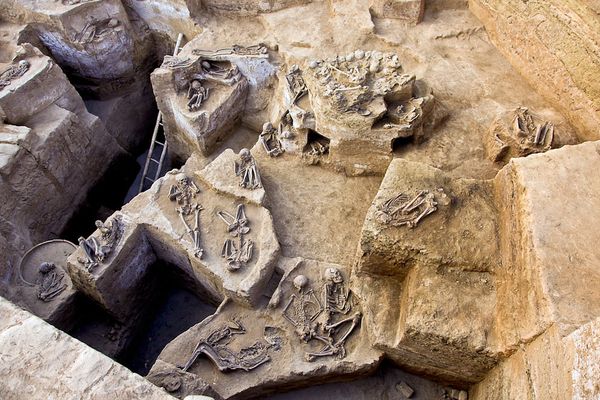
The pyramid is part of the Sicán site, the capital of the Lambayeque people—also known as the Sicán—who ruled Peru’s northern coast from about A.D. 900 to 1100.
Perhaps more than a hundred bodies—buried nude and some of them headless—lie in the newfound pit…
The brewery’s placement on the edge of the pit suggests the Sicán held a solemn burial feast in which vast quantities of chicha were consumed by the living and offered to the dead.
I would’ve thought that pyramids and ritual sacrifice would be enough to suggest strong cultural connections (between the Inca and Aztec) but archaeologists want to see the same pattern on earthenware…


Well, “pyramidal mounds” and human sacrifice are known from China, Iron Age Scandinavia, Mesopotamia, etc. It is not a rocket science to pile up dirt or stone to a pyramidal shape and sacrifice people. But I suppose you believe these are the remains of your mysterious elders who upheld the “strong” cultural connections throughout the world…?
Well, the MesoAmericans had been to South America to fetch their mica, and they could’ve walked, so it’s not too far out to think that cultures that knew each other if they built huge pyramidal mounds (people sometimes forget that while it might seem obvious to build a pyramid, building a gigantic one is quite different), and sacrificed humans, and believed in a series of world ages, and had similar stories about Viracocha / Quetzalcoatl / Kukulkan. The orthodox answer to universal pyramids would be more believable if those people who were on their own – in the Amazon or New Guinea for example – built pyramids, even little ones.
there seems to be something very odd about that excavation. The remains are all at different levels. How did the excavators know where to start and when to stop? Are there more below the ones exposed? Even stranger still, why did those doing the burials arrange them at these different levels? In our graveyards across the planet, generally people are placed the same depth down each time. It makes no sense to keep digging down and down.