


2012: Transit of Venus
The planet Venus was important to the Maya civilization, who developed a religious calendar based in part upon its motions, and held the motions of Venus to determine the propitious time for events such as war. They named it Noh Ek’, the Great Star, and Xux Ek’, the Wasp Star. The Maya were aware of the planet’s synodic period, and could compute it to within a hundredth part of a day. (source: Wikipedia)
The Transit of Venus is pretty much the same as a solar eclipse, except that it is Venus passing in front of the Sun, and not the Moon. The other key difference is that from our point of view Venus appears much smaller in the sky, and it will not blot out the Sun:
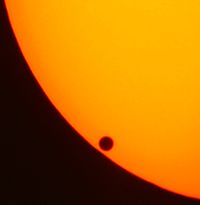
Transits of Venus only occur roughly every 100 years, in pairs that are 8 years apart. The first of the current pair was in 2004, and the second is on June 6, 2012. That will be last transit until 2117. Perhaps it is not a coincidence that the Long Count calender ends just a few months after a transit? If the use of the winter solstice was symbolic, then the transit could be what the ancient Mayans were warning us of?
Orthodox science tells us that solar eclipses do not affect our planet (they do, but only a little), and the same logic applies to a transit. As with planetary alignments, the gravity involved is negligible. We can rule out gravity. That leaves two other possibilities:
- electrical interference, as in the electric universe
- interruption of the solar wind
According to Immanuel Velikovsky, in Worlds in Collision (pages 166-168) it was common for ancient peoples to describe Venus as having a tail. In Mexico it was called the “star that smoked”, and the Chaldeans said Venus had a beard. In the Talmud it says “Fire is hanging down from the planet Venus”. The Arabs and Babylonians called it “the one with hair.
Proponents of the electric universe will tell you that Pioneer discovered that Venus has an electrically charged plasma tail.
Nothing happened during the transit of 2004, but this time around we are nearing the solar peak, so that might make difference. Perhaps a solar storm in conjunction with the transit is meaningful? According to the research of Will Hart, historically transits seem influential:
- 1518 / 1526 – Cortez conquered Mexico in 1519. The Aztecs were already fearful that something bad would happen.
- 1631 / 1639 – after sunspots being on the increase for 300 years, in 1640 they ceased for 70 years, causing the Little Ice Age.
- 1761 – 1769 – nothing mentioned by Hart, but in 1761 it seems every country was at war.
- 1874 / 1882 – Krakatoa erupted in 1883.
I believe people should be especially prepared and vigilant for 6 months either side of Dec 2012, and being ready this June would be prudent. The Maya had a keen interest in Venus, the Aztecs expected the worst during transits, and of course we are now already in the fateful year of 2012…


Nothing happened in 2004? It did. December 26, 2004 – Indian Ocean earthquake and tsunami.
Good point!
[…] there is a rare transit of Venus June 5-6. I’m guessing that an eclipse so close to a transit is super […]