


Safety from Meteorites / New SuperVolcano?
Models that have looked into the effects of a major meteorite impact have, until now, used a featuresless perfect sphere to represent Earth. A new model that incorporates the surface features of our planet has found:
…that the seismic waves resulting from the impact would have been scattered and unfocused, causing less severe ground displacement, tsunamis, and seismic and volcanic activity than previously thought.
So instead of the ripples in a swimming pool being quite uniform, we have ripples in say a small river, with some ducks, a fallen tree, and a pile of mud getting in the way. This means that there will be some areas, even reasonably close to the impact, that will survive intact. If there is ever going to be advanced warning of a large impact, such a model might be able to help humans choose the safest places to hide.
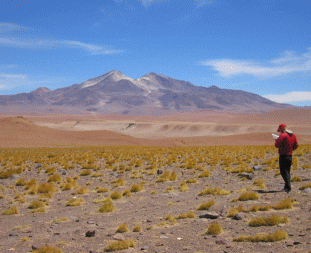
Uturuncu is an ancient volcano in southwest Bolivia. It last erupted 300,000 years ago, and that eruption does not classify it as a supervolcano. However, lately it is been giving indications that it could be a supervolcano in the making:
So far, they know the inflation is surprisingly fast: the center of the patch has risen 7.9 inches (20 centimeters) in the past 20 years. What is more, the uplift extends about 43 miles (70 kilometers) across — similar in size to the caldera that formed in the wake of the latest eruption of the Yellowstone supervolcano, which blanketed half of the U.S. in ash 640,000 years ago.
…Uturunca could be drawing magma from a dense swarm of nearby volcanoes, many of which are currently active.
The risk it currently presents depends on how long it has been inflating for, and satellite data only goes back 20 years. The investigating geologists say the expansion probably started only recently, and so the magma chamber probably has not yet grown to supervolcanic proportions, but also note that their initial conclusions are far from definitive.


