

Dark Comets »

Another Expert Agrees With Dark Comet Theory

February 21, 2013 – 11:31 am | No Comment

Astronomer David Asher (from Armagh University) has agreed with Bill Napier and Janaki Wickramasinghe (Cardiff University) that “dark comets” are real and dangerous.
The following quotes are from a paper by Napier and Asher published in Astronomy & Geophysics.
http://star.arm.ac.uk/preprints/2009/539.pdf

We know that about one bright comet (of absolute magnitude as bright as 7, comparable to Halley’s Comet) arrives in the visibility zone (perihelion q<5AU, say) each year from the Oort cloud. It seems to be securely established that ~1–2% of these are captured into Halleytype (HT) orbits. The dynamical lifetime of a body in such an orbit can be estimated, from which the expected number of HT comets is perhaps ~3000. The actual number of active HT comets is ~25. This discrepancy of at least two powers of 10 in the expected impact rate from comets as deduced from this theoretical argument on the one hand, and observations on the other, is …

Read the full story »
Bunkers

From DIY to Russian megabunkers

Survivalism

Preparing for when the SHTF

Pole Shift

Crustal displacements and magnetic pole shift – both are scary

Comets

Don’t believe NASA – these are a genuine threat

Earthquakes

More likely during eclipses and perhaps Comet Elenin is a factor?

Home » Megafauna

Killer Koala Unearthed
Submitted by on July 6, 2011 – 2:03 amNo Comment
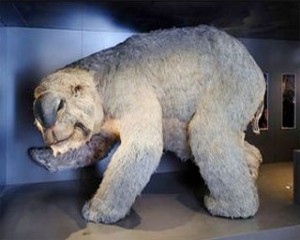
diprotodon

Photo courtesy of Australian Museum

Like a giant (size of a rhino) cross between a wombat and a koala, the Diprotodon supposedly died out in Australia 25,000 years ago. As with all other extinct megafauna, experts figure that they were either eaten to extinction by people, or they succumbed to disease or climate change. On the first count, I wouldn’t be surprised if the eating was done by the beast!

As a catastrophist who has noticed that most megafaunal extinctions coincided with a global cataclysm roughly 11,000 years ago, I figure they’ll find that this or other specimens of Diprotodon lived more recently that 25,000 years ago.

I look forward to the date determined for this new find, as described today in the Cairns Post:

Scientists believe they are on the verge of unearthing a prehistoric graveyard after digging up a complete skeleton of the world’s largest marsupial on a Far Northern cattle property. Researchers hit the jackpot after finding the remains of the massive Diprotodon at Floraville Station, on the Leichhardt River between Normanton and Burketown.

The Diprotodon, which was about the size of a four-wheel drive, was widespread across Australia and believed to co-exist with indigenous people until it became extinct about 25,000 years ago.

…”It potentially has information about how long the mega fauna may have survived in the northern part of Australia,” Prof Hand said.

“Because it’s so well preserved, there could be a lot of information that can be retrieved from it.” Prof Hand believed the discovery could also point to a prehistoric graveyard of other animals at the site.

“If you’ve got this much of a skeleton of one of these big beasts, and usually they’re quite dispersed and you don’t get them sitting there nicely, it suggests that some more work could turn up a mega faunal graveyard,” she said.

Leave a comment!

Add your comment below, or trackback from your own site. You can also subscribe to these comments via RSS.

Be nice. Keep it clean. Stay on topic. No spam.

You can use these tags:
<a href="" title=""> <abbr title=""> <acronym title=""> <b> <blockquote cite=""> <cite> <code> <del datetime=""> <em> <i> <q cite=""> <s> <strike> <strong>

This is a Gravatar-enabled weblog. To get your own globally-recognized-avatar, please register at Gravatar.