


Will Betelgeuse Go Supernova?
There has been enough internet chatter for the Bad Astronomy blog to address the subject. The known facts appear to be:
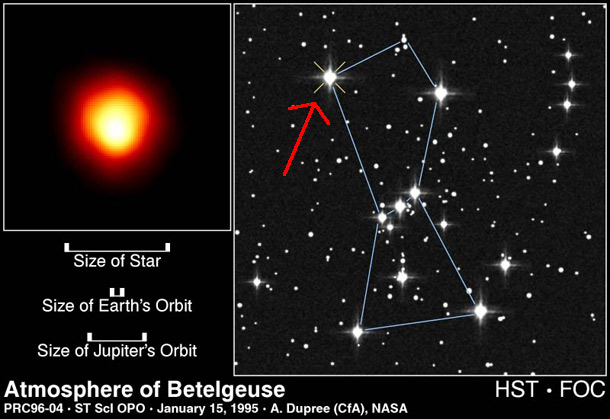
- The shape of Betelgeuse is changing, indicating a potential supernova – although it might be many, many years away…
- Orthodox science says that only a supernova of 25 light years away (or closer) could harm us, but Betelgeuse at 600 light years cannot
- When it does explode, it will be as bright in the sky as the full moon. But appearing much smaller, it will be more intense, and perhaps painful to look at directly
My key concern is the absolute certainty scientists seem to have regarding the harm that can come from supernovas more distant than 25 light years. We receive regular reports of new types of supernova, or stars that do not fit pre-existing models. It seems quite clear that our knowledge of stars is far from complete, that new types of stars and supernova are bound to be discovered, and something bigger and nastier than we have observed to date will exist. To suggest that we are 100% safe is naive.
Nothing travels faster than light, but we can potentially be hit with radiation directly after a supernova becomes visible. If you see a supernova, quit staring and get ye to a bunker or similar ASAP. If it turns out to be nothing, you can watch it on YouTube later. If it is a catastrophe, you’ll be one of the few that ducked for cover.
UPDATE
The following is sourced from Seeing Red by Gary A. Davin, in Mindscape 005.
Hopi legends talk about the arrival of the Red Star Kachina at the end of the current Fourth World in order to purify humankind. The Maya saw Betelgeuse as the Red Dragonfly associated with Kukulkan, and the related Aztec god Quetzalcoatl was sometimes depicted with red skin and a dragonfly headdress. Both gods are said to appear at the conclusion of present cycle.
According to authors Chris Morton and Ceri Thomas, The Maya considered the dragonfly to be one of the symbols of Kukulcan also known as Quetzalcoatl whose spirit is said to be connected with the fulfillment of the Mayan Calendar.


It started last August …. it sent a wave of Gama Radiation in our direction, that is just starting to arrive … this is partially why we have the wacky weather. Our Atmosphere will continue to heat uf as the full force of the Gama Rays arrive
So we are assuming here that what we see with our telescopes from our region of space is in real time? Come on people! it’s 600 light years away! What we are seeing happend long before we first saw it. In other words if it goes supernova today at 11:33 PM est. we would never know till it happens. The initial “frequency shock wave” would hit us before the gamma burst particals. IMO the frequency shock wave passed through our solar-system already in 1998, which means Betelgeuse already went supernova long ago. How long would it be before the gamma ray burst hits? How close to the speed of light, can a gamma burst travel? At 600 LYs away, i would say no more than 1,000 years, no less than 600 years. How ever is Betelgeuse not one of the the biggest known stars? When was Betelgeuse known to have first come into view with the naked eye? Are the images an indication of a super nova to come, or one that has already happend?