

Dark Comets »

Another Expert Agrees With Dark Comet Theory

February 21, 2013 – 11:31 am | No Comment

Astronomer David Asher (from Armagh University) has agreed with Bill Napier and Janaki Wickramasinghe (Cardiff University) that “dark comets” are real and dangerous.
The following quotes are from a paper by Napier and Asher published in Astronomy & Geophysics.
http://star.arm.ac.uk/preprints/2009/539.pdf

We know that about one bright comet (of absolute magnitude as bright as 7, comparable to Halley’s Comet) arrives in the visibility zone (perihelion q<5AU, say) each year from the Oort cloud. It seems to be securely established that ~1–2% of these are captured into Halleytype (HT) orbits. The dynamical lifetime of a body in such an orbit can be estimated, from which the expected number of HT comets is perhaps ~3000. The actual number of active HT comets is ~25. This discrepancy of at least two powers of 10 in the expected impact rate from comets as deduced from this theoretical argument on the one hand, and observations on the other, is …

Read the full story »
Bunkers

From DIY to Russian megabunkers

Survivalism

Preparing for when the SHTF

Pole Shift

Crustal displacements and magnetic pole shift – both are scary

Comets

Don’t believe NASA – these are a genuine threat

Earthquakes

More likely during eclipses and perhaps Comet Elenin is a factor?

Home » Floods

Cities At Risk of Super Cyclones

Submitted by on December 11, 2012 – 8:40 pmNo Comment

There are two parts to this story from Cosmos Magazine:

“A black swan is a surprise with huge impact,” she said yesterday at a meeting of the American Geophysical Union in San Francisco, California. “For this study, we defined [it] as an event which cannot reasonably be anticipated based on historical records alone.”

1. A “black swan” cyclone has the intensity of Superstorm Sandy, but would occur somewhere such an event has not previously been recorded. According to the news item a similar storm hit New York in the 19th century. Computer simulations have enabled scientists to make a short list of places where a super cyclone could occur, even though none have previously.

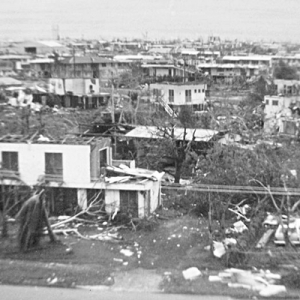
2. Darwin, Tampa and Dubai made that short list. Darwin (see below) and Tampa have some degree of cyclone expectation, so presumably they are reasonably prepared. But Dubai is the big stand out. I have no idea how that kind of terrain (all sand) would cope, and I doubt they have much drainage set up in such a dry land to cope with a 10 meter flood. It could be truly devastating for them one day – but fortunately that could be thousands of years into the future.

Offshore from Darwin – the capital of Australia’s Northern Territory – the waters are also shallow and hot. And, devastating as it was – Cyclone Tracy killed 65 people and destroyed 70% of the city’s homes – Tracy was a “compact” storm that produced a storm surge of only 1.6 meters, a mere kitten compared to what her simulations show might happen every 20,000 or 30,000 years.
Leave a comment!

Add your comment below, or trackback from your own site. You can also subscribe to these comments via RSS.

Be nice. Keep it clean. Stay on topic. No spam.

You can use these tags:
<a href="" title=""> <abbr title=""> <acronym title=""> <b> <blockquote cite=""> <cite> <code> <del datetime=""> <em> <i> <q cite=""> <s> <strike> <strong>

This is a Gravatar-enabled weblog. To get your own globally-recognized-avatar, please register at Gravatar.