

Dark Comets »

Another Expert Agrees With Dark Comet Theory

February 21, 2013 – 11:31 am | No Comment

Astronomer David Asher (from Armagh University) has agreed with Bill Napier and Janaki Wickramasinghe (Cardiff University) that “dark comets” are real and dangerous.
The following quotes are from a paper by Napier and Asher published in Astronomy & Geophysics.
http://star.arm.ac.uk/preprints/2009/539.pdf

We know that about one bright comet (of absolute magnitude as bright as 7, comparable to Halley’s Comet) arrives in the visibility zone (perihelion q<5AU, say) each year from the Oort cloud. It seems to be securely established that ~1–2% of these are captured into Halleytype (HT) orbits. The dynamical lifetime of a body in such an orbit can be estimated, from which the expected number of HT comets is perhaps ~3000. The actual number of active HT comets is ~25. This discrepancy of at least two powers of 10 in the expected impact rate from comets as deduced from this theoretical argument on the one hand, and observations on the other, is …

Read the full story »
Bunkers

From DIY to Russian megabunkers

Survivalism

Preparing for when the SHTF

Pole Shift

Crustal displacements and magnetic pole shift – both are scary

Comets

Don’t believe NASA – these are a genuine threat

Earthquakes

More likely during eclipses and perhaps Comet Elenin is a factor?

Home » Tsunami

East Coast USA Has Tsunami Threats

Submitted by on November 30, 2012 – 11:09 pmNo Comment

The biggest tsunami threats to the USA are on the West Coast. But that doesn’t mean the East Coast is immune. And to make things worse, because they aren’t expecting a tsunami, they won’t be prepared when one arrives.
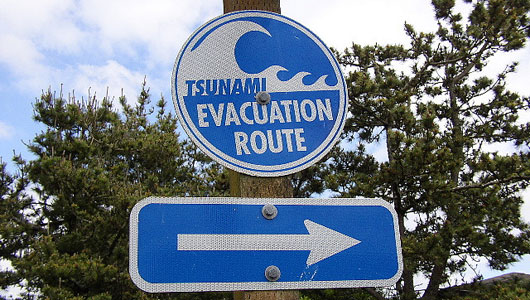
To be fair, most of the threats are negligible:

  • Puerto Rico Trench – it is a subduction zone, but it is the Caribbean that is at risk, not the USA
  • Azores-Gibraltar Transform Fault, off the coast of Portugal – it destroyed Lisbon in 1755, but the USA wasn’t affected
  • Cumbre Vieja (Canary Islands) – a 2001 study suggested this series of events could send a 70-foot (21 m) wave crashing into the East Coast, but other studies since have decided it would only reach a height of a couple of feet

The biggest risk is from a submarine landslide near the U.S. coast. The resultant tsunami would dissipate quite quickly, so the landslide would need to be near a populated area. Experts are still in the process of mapping where these risks lie.

Completely missing from the Mother Nature Network article is the risk from asteroids and comets. While they don’t happen as frequently as earthquakes and landslides, the tsunamis they can generate are massively larger and more lethal.

Leave a comment!

Add your comment below, or trackback from your own site. You can also subscribe to these comments via RSS.

Be nice. Keep it clean. Stay on topic. No spam.

You can use these tags:
<a href="" title=""> <abbr title=""> <acronym title=""> <b> <blockquote cite=""> <cite> <code> <del datetime=""> <em> <i> <q cite=""> <s> <strike> <strong>

This is a Gravatar-enabled weblog. To get your own globally-recognized-avatar, please register at Gravatar.