


Science: Mass Violence Due Soon
All of my 2012 work has revolved around aspects that are scientifically plausible – even if sometimes they are a bit “out there”. Here’s something that is definitely scientific, Violence Due in 2020:
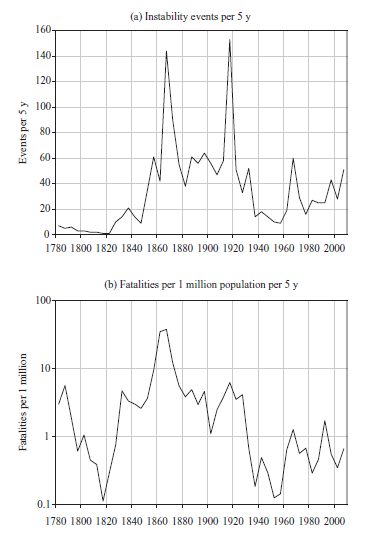
Professor Peter Turchin suggests that peaks of violence in the US work on a 50-year cycle, with the next state of upheaval set to hit humanity in 2020.
If the violence is to peak in 2020, I guess that means we should soon see rises in the three types of violence Turchin describes:
- “groups on groups,” which, in the case of modern-day America, would be riots
- “groups against individuals,” which would be lynchings and that kind of thing
- “individuals against groups,” which are what we call rampage killings (example, the Dark Knight shootings)
Turchin points out that rampage killings rose 20-fold in the last generation
I guess the question is this: are the prepper militia groups in the USA just really smart in preparing for just such an event. Or are they the event?
But I have another question – how good is the science behind this? In a recent issue of New Scientist is more information:
In particular, it predicts that social collapse and widespread violence do not rear their heads when life first gets grim for the working classes, as you would expect if workers’ misery were the catalyst. Instead, unrest should follow a generation or two later, because it takes that long to accumulate an excess of wealthy, highly educated elites. This is exactly what Turchin found when he compared the timing of collective violence with economic indicators such as wages, social inequality and population growth – a measure of labour supply – in the three civilisations.
Turchin says the the violence arises politically – and I figure it could be summed up like this… Economics works in cycles, and two generations after a depression is when the rich are richest, and the poor have had enough of their continual failure to improve their lot. Plus if you get too many political rich people, they will fight.
The events in the graph are the three types listed above, and only if they had a fatality – USA figures:
The following quotes are from Turchin’s paper on the topic:
The most common issues in the USPV database are (1) race or ethnicity, (2) labor-management conflicts, and (3) politics, including election disputes.
Race/ethnicity has been an important issue throughout US history, and was the common motive of riots, lynchings, and assassinations during the peaks of 1870, 1920, and 1970. In contrast, the importance of other issues waxed and waned. Thus, politics was an important issue in c.1870 (election riots and sectional violence) and again in c.1970 (the Civil Rights and Antiwar Movements). In contrast, labor issues (in the form of violent and increasingly lethal strikes) reached their peak c.1920.
Political violence in the years around 1920 similarly took multiple forms and was motivated by diverse issues. During the Red Summer of 1919 there were no fewer than 26 major race riots that collectively caused more than 1,000 fatalities. This was also a period of intense class warfare, with labor strikes becoming increasingly more violent. To give just one example, the Battle of Blair Mountain in West Virginia in 1921 was the largest organized armed uprising in US labor history (it was also the only time in US history when the government used military aircraft against its own people). Elite insecurity was further aroused by the terror campaign conducted by Italian anarchists and by electoral challenges from the populists and socialists. The widespread belief among the elites during the Red Scare of 1917–21 that the country was on the brink of revolution was not just paranoia.
The last clearly defined peak around 1970 was also due to a variety of incidents: urban riots and violent campus demonstrations, political assassinations, and terrorism. However, the level of violence achieved during this peak was much milder than that during the previous peaks.
None of those examples caused a breakdown of society of the type that prepper militias fear. But they do contain similar elements that perhaps we should be looking out for:
Righteous Political Leaders Seek Change – historical cases include where there were powerful men disagreeing about the legitimacy of slavery, the effectiveness of prohibition, the idea of fighting other people’s wars.
Regular People Commit The Violence – none were settled by two gentlemen having a duel. Neither were leaders lynched. Indeed, who were the leaders?

So we should be looking out for the following:
- New political groups comprising of minorities (like the Black Panther Party)
- New political groups comprising of the poor (watch out for the 1% movement finding a better defined purpose and a leader)
- New political groups railing against technological bullying (Anonymous of course – if only they could stick to the most legitimate targets)
Ultimately the two biggest worried going forward are FEAR and HATRED. Both can be fixed with education.


