

Dark Comets »

Another Expert Agrees With Dark Comet Theory

February 21, 2013 – 11:31 am | No Comment

Astronomer David Asher (from Armagh University) has agreed with Bill Napier and Janaki Wickramasinghe (Cardiff University) that “dark comets” are real and dangerous.
The following quotes are from a paper by Napier and Asher published in Astronomy & Geophysics.
http://star.arm.ac.uk/preprints/2009/539.pdf

We know that about one bright comet (of absolute magnitude as bright as 7, comparable to Halley’s Comet) arrives in the visibility zone (perihelion q<5AU, say) each year from the Oort cloud. It seems to be securely established that ~1–2% of these are captured into Halleytype (HT) orbits. The dynamical lifetime of a body in such an orbit can be estimated, from which the expected number of HT comets is perhaps ~3000. The actual number of active HT comets is ~25. This discrepancy of at least two powers of 10 in the expected impact rate from comets as deduced from this theoretical argument on the one hand, and observations on the other, is …

Read the full story »
Bunkers

From DIY to Russian megabunkers

Survivalism

Preparing for when the SHTF

Pole Shift

Crustal displacements and magnetic pole shift – both are scary

Comets

Don’t believe NASA – these are a genuine threat

Earthquakes

More likely during eclipses and perhaps Comet Elenin is a factor?

Home » Megafauna

If the Spotted Horse was real, then…

Submitted by on November 9, 2011 – 11:59 pmNo Comment

I actually hadn’t heard of the spotted horse before today.
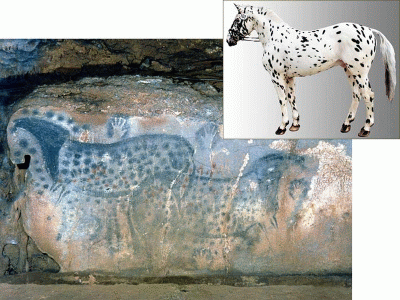
The spotted horse exists as art found in a Spanish cave that is 25,000 years old – much older than the last global cataclysm, and predating the megafaunal extinction. It is easy to dismiss the dots as purely artistic stylings, but as we keep learning, ancient myths and images tend to be more literal than we expect.

…a small number of caves, including 25,000-year-old Pech Merle in southern France, feature horses painted white with black spots. Some archaeologists have argued that this leopard-like pattern was fanciful and symbol laden rather than realistic. Indeed, in a 2009 analysis of DNA from the bones of nearly 90 ancient horses dated from about 12,000 to 1000 years ago, researchers found genetic evidence for bay and black coat colors but no sign of the spotted variety, suggesting that the spotted horse could have been the figment of some artist’s imagination.

I’d be convinced, except they used the DNA of horses that survived the cataclysm.

Thankfully the team behind the original study decided to find older DNA and they hit the jackpot:

They found that 18 of the horses were bay, seven were black, but six had a genetic variant—called LP—that corresponds to leopard-like spotting in modern horses. Moreover, out of 10 Western European horses estimated to be about 14,000 years old, four had the LP genetic marker, suggesting that spotted horses were not uncommon during the heyday of cave painting.

All three color types appear in cave art, which means that they are accurate depictions of the horses of the day. The scientists have made the usual stabs at guessing why this breed of horses became extinct, but of course did not look at any catastrophic scenarios.

So, once more I am asking myself, were dragons and unicorns once real?

Leave a comment!

Add your comment below, or trackback from your own site. You can also subscribe to these comments via RSS.

Be nice. Keep it clean. Stay on topic. No spam.

You can use these tags:
<a href="" title=""> <abbr title=""> <acronym title=""> <b> <blockquote cite=""> <cite> <code> <del datetime=""> <em> <i> <q cite=""> <s> <strike> <strong>

This is a Gravatar-enabled weblog. To get your own globally-recognized-avatar, please register at Gravatar.