

Dark Comets »

Another Expert Agrees With Dark Comet Theory

February 21, 2013 – 11:31 am | No Comment

Astronomer David Asher (from Armagh University) has agreed with Bill Napier and Janaki Wickramasinghe (Cardiff University) that “dark comets” are real and dangerous.
The following quotes are from a paper by Napier and Asher published in Astronomy & Geophysics.
http://star.arm.ac.uk/preprints/2009/539.pdf

We know that about one bright comet (of absolute magnitude as bright as 7, comparable to Halley’s Comet) arrives in the visibility zone (perihelion q<5AU, say) each year from the Oort cloud. It seems to be securely established that ~1–2% of these are captured into Halleytype (HT) orbits. The dynamical lifetime of a body in such an orbit can be estimated, from which the expected number of HT comets is perhaps ~3000. The actual number of active HT comets is ~25. This discrepancy of at least two powers of 10 in the expected impact rate from comets as deduced from this theoretical argument on the one hand, and observations on the other, is …

Read the full story »
Bunkers

From DIY to Russian megabunkers

Survivalism

Preparing for when the SHTF

Pole Shift

Crustal displacements and magnetic pole shift – both are scary

Comets

Don’t believe NASA – these are a genuine threat

Earthquakes

More likely during eclipses and perhaps Comet Elenin is a factor?

Home » Supernova

Supernova Theory Wrong?
Submitted by on April 9, 2009 – 11:41 pmNo Comment

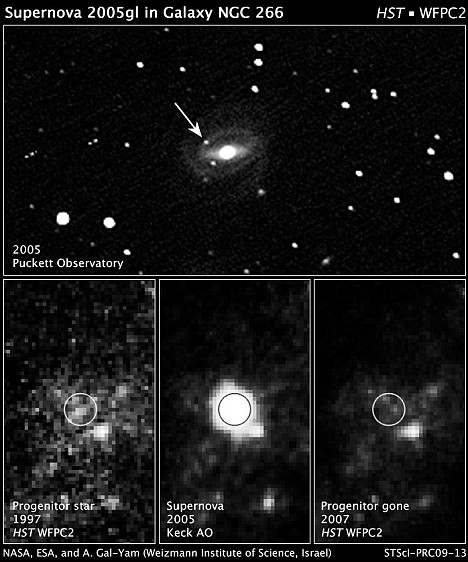
It looks like the previously accepted theory regarding the life cycle of Luminous Blue Variable (LBV) stars is faulty. It had been thought that LBVs needed to first evolve a massive iron core of nuclear fusion ash, lose most of their hydrogen envelope, and only then would they be primed for a core implosion that would trigger a supernova.

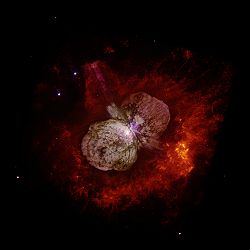
However before and after photos of supernova SN 2005gl have shown that pre-explosion it was a LBV that had not lost most of its hydrogen envelope. This places it in the same category of LBV Eta Carinae, which is only 7500 light years from Earth.

From Wikipedia:

Due to the similarity of Eta Carinae and SN 2006jc, Stefan Immler of NASA’s Goddard Space Flight Center suggests that Eta Carinae could explode in our lifetime or even in the next few years. However, Stanford Woosley of the University of California in Santa Cruz disagrees with Immler’s suggestion, and he says it is likely that Eta Carinae is at an earlier stage of evolution and that it has several kinds of material left for nuclear fusion.
Leave a comment!

Add your comment below, or trackback from your own site. You can also subscribe to these comments via RSS.

Be nice. Keep it clean. Stay on topic. No spam.

You can use these tags:
<a href="" title=""> <abbr title=""> <acronym title=""> <b> <blockquote cite=""> <cite> <code> <del datetime=""> <em> <i> <q cite=""> <s> <strike> <strong>

This is a Gravatar-enabled weblog. To get your own globally-recognized-avatar, please register at Gravatar.